Posts

The Poe Outro

Image
In pop music, an “outro” is the concluding segment of a song—the word is made up from the opposite term, an intro , which is the introductory portion: it can be a guitar riff, a distinctive drumbeat, or a combination of similar elements. The introduction to Beethoven’s Fifth (or Symphony No. 5 in C minor) has been called “the most famous four notes in music history” and you can probably hear the ‘ ta-ta-ta-tum ’ in your head as you read this.  (It said “ saxo-mo-phone ,” to Homer Simpson.)   In the world of pop music, the Beatles were prone to writing memorable outros in songs like “Hey Jude” (‘Na, na, na-na, na-na,’ etc.), “Drive My Car” (‘Beep-beep ‘n beep-beep, yeah’) and “Ticket to Ride” (‘My baby don’t care’). All of these outros switched gears from the verse-chorus-verse-chorus pattern that preceded them into a repetitive loop that was intended to fade out as the song ended. That same idea—a repetitive pattern that takes us out of the pattern set up in the main body—w...
The Holy Dream

Image
Edgar Allan Poe’s “A Dream” (1827) echoes the same sentiments as “A Dream Within A Dream” (1849) , written almost a quarter century later. I have written previously that “A Dream Within A Dream” denotes a happy dream (the past) wrapped up in a miserable dream (the present). That poem and the other poem considered here juxtapose a vivid happiness recalled through dreams, against a present-day reality so jaded and faded that it resembles a dream state.   Both poles recur often in Poe’s poetry. The dream past is recalled in poems such as “Dreams” (1827) (“ I have been happy, tho’ in a dream/I have been happy—and I love the theme ”) and “Annabel Lee” (1849) (“ For the moon never beams without bringing me dreams/Of the beautiful Annabel Lee ”). The sleepwalking present is evidenced in “To One in Paradise” (1833) (“ And all my days are trances ”) and “Ulalume” (1847) (“ I replied—'This is nothing but dreaming’ .”) Dreams are a hot topic in Poe’s oeuvre .   In “A Dream,” the poe...

Living ‘The Dream’ (Poe style)

Image
All that we see or seem Is but a dream within a dream. So asserts Edgar Allan Poe in his immortal poem, “A Dream Within A Dream” (1849) . In an earlier post , we explored the allegorical structure of the poem. In this follow-up, I want to drive home the meaning of the phrase “ A dream within a dream ,” because it has a very precise meaning in Poe’s verse. It doesn’t just mean “ a mystery wrapped in a riddle inside an enigma! ” ( “JFK,” 1991. ) That works well as a secondary meaning, as connotative reading of the phrase, but Poe has something more explicit in mind. Specifically, Poe is saying that all that he pictures in his mind’s eye is a nostalgic vision (“ dream ” #1, which he “ sees ”), which is contained within the trancelike existence of his waking reality (“ dream ” #2, which is his life as it “ seems ”). Those two poles demarcate the boundaries of “ All ” his experience and the same is true, Poe boldly posits, for every one of us. All of our lives are waking trances...

June gloom

Image
Photo uploaded by user Erisa on Pinterest . June figures in two of Edgar Allan Poe’s poems; in the early piece “A Pæan” (1831) and the later work “The Sleeper” (1841) . Though set a decade apart, both poems deal with the death of a beautiful woman —which Poe famously called “ unquestionably, the most poetical topic in the world ”—and, in both pieces, June is used to mark a midway point, a halfway station in the journey of life. In “The Sleeper,” June’s placement in the middle of the calendar is emphasized or heightened by the other temporal references. The poem is set “ at midnight, in the month of June .” Thus, it is not only the middle of the year, but also the middle of the night and, furthermore, the moment straddling the dividing line between one day and the next day. In “A Pæan,” the month is used to characterize the relative youth of the dead heroine: “Thou died’st in thy life’s June.” Poe does this often in other poems—he refers to the human lifespan by reference to t...

Gazing at Poe’s “Evening Star”

Image
If you gaze up at the sky after sunset, you can admire Poe’s “Evening Star” (Venus, the subject of an 1827 poem) and, just before sunup in the morning you can see the “ cold moon/’Mid planets her slaves ,” as the waning moon will then be accompanied by three bright planets : Jupiter, Saturn and Mars. Last week, while the moon was in its full phase, I took my eight year-old daughter out to our backyard for a poetry reading and astronomy lesson under the jaw-droppingly bright Venus, the “Evening Star” (though we can be agreed it’s not really a “star”). Unusually clear skies in L.A. due to the Coronavirus shutdown will soon be the stuff of legends, but they were enough of a reality still this past week for us to engage in stargazing after sunset, and exploring poetry, too. Poe’s “Evening Star” is easy reading that lets you meditate, lightly, on why the heavens have such an indelible hold on human imagination. As I said to my daughter augustly: “the thinking person likes to look at...

Poe in the time of Coronavirus

Image
The Phantom of the Opera (1925) When I started this blog and throughout its life, I have resolved to focus exclusively on the poetry of Edgar Allan Poe. Today, I write about one of his short stories— “The Masque of the Red Death” (1842) —because of its relevancy given the Coronavirus pandemic. But I will also focus on its poetry rather than its value as a short story, and I will contrast the themes it presents with those I have analyzed in Poe’s verse. In times of COVID-19, it is impossible for a Poe buff not to think of The MRD. You have a highly infectious plague ravaging the planet. There is no test, no cure, and no stopping the spread of the contagion. The only recourse to those who wish to survive is to self-quarantine. But this is Poe, so the isolation is not behind hermetically sealed, Ebola-styled plastic enclosures, but—wait for it—in a “castellated abbey”. The quarantine party consists of Prince Prospero and a thousand of his closest friends in the nobility, who turn...

“Dead” can entrance

Image
Tommy Woodard © 2014 There is a scene in the classic horror movie, “The Bride of Frankenstein” (1935) in which the Monster (Boris Karloff) finds Dr. Frankenstein’s fellow mad scientist Dr. Pretorius (Ernest Thesiger) dining in a burial vault, using a coffin lid as a tabletop. The sequence is a classic Gothic scene because settings such as cemeteries and themes like commingling with the dead are recurring themes inherited from Romanticism. In the movie, Pretorius is an old man, and as a mad scientist, he is a certified odd fellow; but the idea of a young man communing with the dead is an especially stark one. Edgar Allan Poe was just 18 when he composed “Spirits of the Dead” in 1827, but he was certainly not the first poet to explore the subject—not by a long shot!   One thinks, for example, of Thomas Gray’s masterpiece, “Elegy Written in a Country Churchyard” (1751) , written a century earlier, when Gray was 26 years old. If Poe was right that “ The death of a beautiful wo...

Edgar Allan Poe’s “Vampyre”

Image
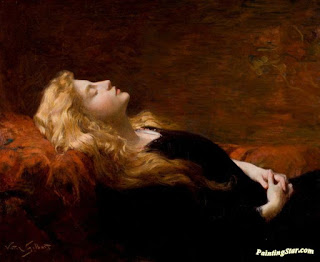
Sleeping Beauty by Victor Gabriel Gilbert This year, for Halloween, Poe’s “The Sleeper” (1841) is dressing up as a vampire. Actually, she doesn’t really need a costume because if we look at her closely, we may observe that she already fulfills the requirements. Let’s face it, the poem begins at midnight, under a full moon, amid foggy ruins, nodding flowers and a drowsy lake, and we find our undead heroine, Irenë, sleeping in an open coffin. As I pointed out in my earlier analysis (which included a recitation of the poem), an earlier draft of the poem included the word “ vampyre ” in the verse. In fairness, the word was only used as an adjective, to describe the batwing-like panels of Irenë’s family crypt. But we need not dust-off ancient contents from the vault to appreciate the vampirical elements in the poem because they are there in plain sight. The words of the poem, taken at face value, tell the story of a dead woman who does not appear to be dead, and who finds herse...

The Poe “Zombie”

Image
“Zombie Edgar Allan Poe” by K. Werner If a Voodoo Zombie is someone enslaved by a witch-doctor’s spell; a Romero Zombie is an infectious reanimated corpse; and a Philosophical Zombie is a hypothetical human with no conscious experience who is indistinguishable from a normal person, then a Poe Zombie is a “sentimental” zombie, someone who longs to be loved but is, due to some life trauma, “dead” to the life of the heart. Poe summed up the criteria for a sentimental zombie (though he never used that term) in an early draft of a poem I previously wrote about ( here ) as a “perfect poem.” In an earlier version of the same poem, Poe wrote an intriguing addendum which he later excised: ‘T is not that the flowers of twenty springs Which have wither’d as they rose Lie dead on my heart-strings With the weight of an age of snows. Nor that the grass — O! may it thrive! On my grave is growing or grown — But that, while I am dead and alive I cannot be, love, alone. ...

They are Ghouls

Image
Despite his reputation as a master of the macabre, Edgar Allan Poe did not generally write poems about supernatural bogeymen. Instead, his poems were all about setting up the mood where any bump in the night is suspected to be our dead lover, and melancholy is so thick it turns to dread and suspense that you can cut with a swinging pendulum. Although Poe did not write about ghosts and goblins, he makes one exception for one character who recurs in a few poems: the ghoul. Poe’s ghouls are not central to his narratives, but they are sufficiently developed that we can describe them and distinguish them from the stock archetype. In fact, their peripheral nature blends into the type of character Poe’s ghouls represent—they are background figures, they may be unseen, operating in the shadows.   For example, in the poem “Dream-Land” (1844) , they are mentioned in a passing allusion, merely to add weight to the atmospheric setting: By the grey woods,—by the swamp    W...

Poe vs. “The Conqueror Worm”

Image
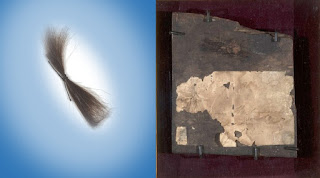
A lock of hair from Poe’s burial (l.); a fragment of his coffin (r.) One hundred and seventy years ago, on October 9, 1849, Edgar Allan Poe was buried in the Westminster Hall and Burying Ground in Baltimore, two days after his unexpected death. Less than ten mourners attended the rained out ritual, which seemed to confirm the conviction expressed by Poe in one of his poems, “The Conqueror Worm” (1843) , which posits that human life is a meaningless absurdity and that the worms that feast on human remains triumph over our very existence: That the play is the tragedy, “Man,”   And its hero, the Conqueror Worm. [Listen to the audio of my recitation of the poem at the foot of this post.] Poe’s poem is gloomy, dismal, fatalistic. It projects itself over some apocalyptic future, “ the lonesome latter years ” in which humanity seems to have been extinguished. The only “ gala ” in this bleak epoch involves “ an angel throng ”—as there appear to be no humans to be found. In Po...

Poetic Justice: The vindication of Edgar Allan Poe

Image
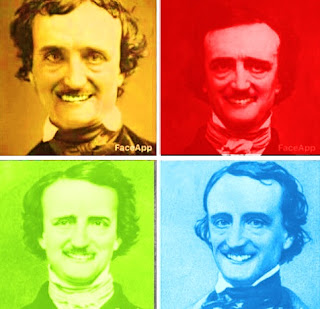
Photographic images of Poe modified with FaceApp to show him smiling. If you have ever read any of the obituaries for Edgar Allan Poe published at the time of his death 170 years ago, you know that they generally lauded him as a knowledgeable and accomplished literary figure who had achieved national renown, but they also contained disclaimers such as he was controversial and not universally liked, as well as the inevitable observation that, because Poe died so young (40), his legacy seemed obviously incomplete. How would we update that analysis today? Go to Wikipedia and you will know that Poe is regarded as a master of the macabre, the father of detective fiction, and an influential literary celebrity, if you will indulge the use of that term. However, Poe the poet remains a somewhat underdeveloped commodity, despite the fact that even the first obituaries acknowledged the popular success of “The Raven,” and his other poetry and essays about poetry have been influential wit...

The Passion of Edgar Allan Poe

Image
Colorized version of the ‘Annie daguerreotype.’ (May/June 1849, possibly commissioned by ‘Annie.’) Edgar Allan Poe’s “For Annie” (1849) recounts a near-death experience that proved to be prophetic, in many ways, as to Poe’s actual death later that year. When Poe died on October 7, 1849, he spent the last couple of days of his life in apparent delirium, speaking incoherently, and “in great distress.” That state is certainly approximated in the “ lingering illness ” described in the poem, characterized by “ moaning and groaning ,” “ sighing and sobbing ,” “ throbbing ,” “ nausea ,” “ thirst ,” and a “ fever/That maddened my brain .” The resemblance to real life was not accidental; the poem is believed to be based on an actual episode in which a troubled Poe purposely overdosed on an opium preparation and nearly died. Not surprisingly, some have surmised that Poe’s real death came under similar circumstances, through another overdose of alcohol or some other substance—though the...

Poe’s autumnal “Bells”

Image
Illustration Edmund Dulac, 1912 Edgar Allan Poe’s “The Bells” (1848) is another example of a poem that must be recited and heard recited aloud and, for that reason, this blogpost includes an audio of my reciting the poem at the bottom of the post. “The Bells” is a composition of sound; it is onomatopoeic— about sound, it imitates sounds and plays with sound to evoke sound, and to evoke emotions evoked by sounds. Like other Poe poems, it relies on the sound effects of words—things like rhyme and alliteration—and on meter, the rhythm of the words when strung together, to create a very musical composition. Poe was inspired by the sound he heard coming from Fordham University's bell tower in the Fordham Manor neighborhood of the Bronx, New York, where Poe lived the last few years of his life (he had also written a poem about the Angelus bells ). Poe adopted the thesis that the bells are metaphor for life, and a thematic construct that divided his poem into four sections. T...

From Eulalie to Ulalume--the Muses of Edgar Allan Poe

Image
A good dozen or so poems by Edgar Allan Poe feature fictional or semi-fictionalized women characters enshrined forever in often heartfelt verse. Today, we will classify ten of them, whom I place in three distinct classes: Most of them are femmes tragiques , the members of Poe’s “dead lovers” club and they include Annabel Lee, Lenore, Ulalume and Irene. An equal number are straight-up muses, women whom he celebrates in romantic odes: Helen, Ligeia, Isadore, and Eulalie. Finally, there is a smaller category, which I call the angels, the helpers, who soothe and succor: they are the down-to-earth Annie and the more ethereal Psyche. One is tempted to generalize and an argument could be made that these characters stand in a spectrum for Poe’s ideal of femininity, but that would probably be an over-simplification because these characters represent different real women, and different thoughts about women; though there may well be some bleed-through. Eulalie, from the prefix “ e...